Twelve-tone row
Internet Art Works Library | NS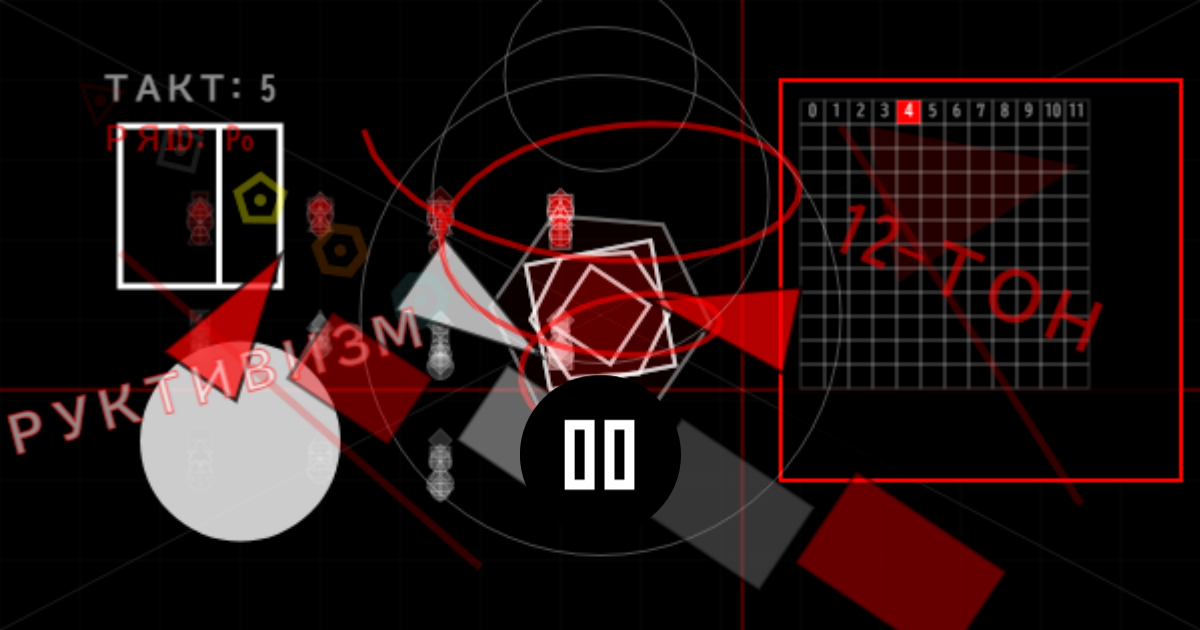
Twelve-tone row
Work created in 2025/8/30
This work’s an experimental internet art piece that reinterprets the 12-tone technique—an innovative compositional method of the 20th century—within a digital environment, embodying it as a real-time generative system. At its core, the piece reconstructs the mathematical structure of the 12-tone technique, established by Arnold Schoenberg, as a form of contemporary algorithmic composition. The principle from Schoenberg’s theory of atonal music, “all notes are equal,” resonates here with the democratic nature of digital media.
The work integrates multiple generative systems. A randomly variable system continuously operates, dynamically altering the number of voices, metric ratios, and transformations of tone rows (including prime, inversion, retrograde, and retrograde inversion forms). Especially noteworthy is the introduction of Fibonacci levels; by applying this mathematical ratio found in nature to musical structure, the artificial algorithm’s endowed with organic growth patterns.
A self-growing system imparts an evolutionary aspect to the work. The display showing “100% progress at stage 0” implies a paradox where the system eternally pursues completeness while constantly changing. This echoes the contradiction inherent in the 12-tone technique itself: the infinite possibilities within a perfectly ordered tone row.
The screen design adopts a strict geometric abstraction. White, gray, and red shapes on a black background clearly signify influences from Bauhaus and Russian Constructivism. The division of the white square in the upper left serves as a visual metaphor for counterpoint in music.
The 12×12 grid in the upper right directly expresses the theoretical foundation of the work, visualizing all possible transformations of the 12-tone row, with red cells serving as an interface indicating current pitch relationships. The concentric orbits in the center spatially represent the cyclic nature of tone row transformations.
One of the work’s most important questions’s the tension between determinism and chance. Through the simultaneous operation of the strict rules of the 12-tone technique and the unpredictability of the random variable system, the piece explores a dialectic of control and liberation.
Furthermore, the multilingual interface (with Russian button texts) highlights the universality of music and hints at the international spread of 20th-century avant-garde music. In particular, the use of Russian can be interpreted as a reference to the lineage from Stravinsky and Prokofiev to today’s Eastern European experimental music.
By revitalizing historical music theory within the context of digital media, “Twelve-tone row” fosters a new dialogue between music and technology. It transcends a mere demonstration of the 12-tone technique, raising fundamental issues of structure and freedom, order and chaos in algorithmic art.
Through real-time interaction, viewers experience the compositional process itself, challenging the passivity of conventional music appreciation and signaling a postmodern aesthetic stance that blurs the boundaries between creation and reception.