Automatism 02
Internet Art Works Library | NS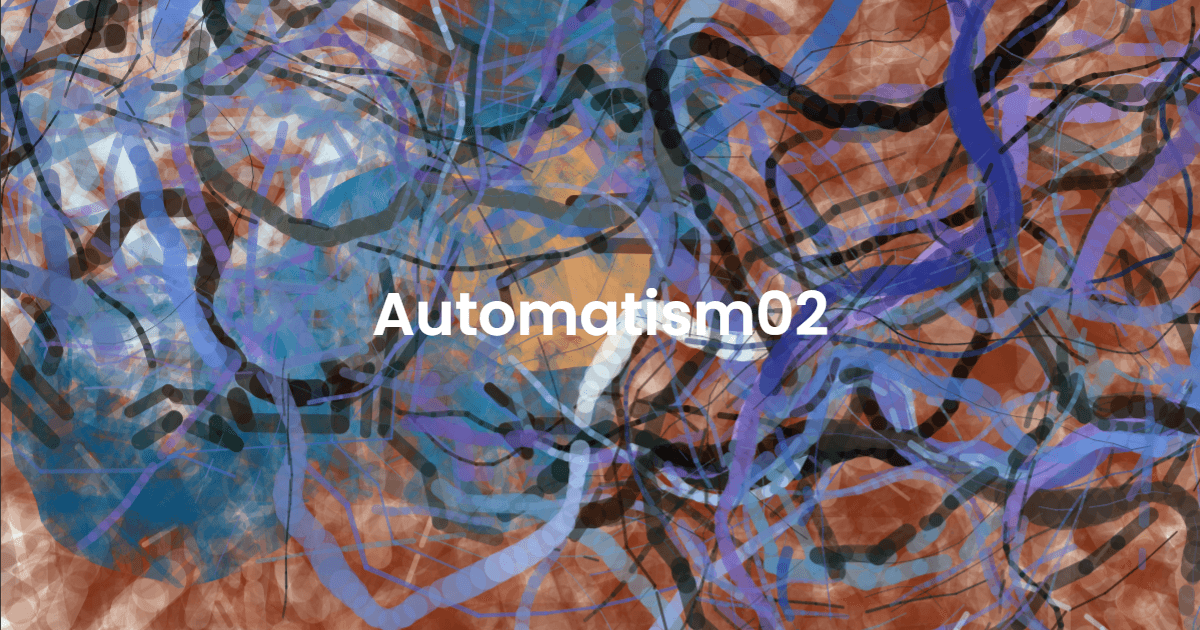
Automatism 02
Work created in 2025/11/8
'Automatism 02' is a generative art piece that fuses early 20th-century avant-garde artistic movements with contemporary electronic music. The title 'Automatism' refers to a method known in Surrealism as 'automatic writing,' a technique that seeks to capture expression emerging from the unconscious by eliminating conscious control. This work transposes that concept into the digital realm, presenting a synchronized visual and sonic expression generated by the algorithmic 'unconscious.'
At the core of the piece lies the collaboration between two JavaScript libraries: p5.js and Tone.js. When the play button is pressed, the screen reveals fluid lines and colors reminiscent of abstract expressionism, while simultaneously unfolding a piece of music filled with contradictions — '1910s experimental music × techno.' When the twelve-tone technique, an innovative compositional method established by Schoenberg and others in the 1920s, merges with a techno beat around 125 BPM, more than a century of musical history becomes folded into a single sonic moment.
Each press of the 'Regenerate' button transforms the piece entirely. At times, it manifests as heavy strokes in brown and blue tones, accompanied by music where lead sounds occupy 76% of the composition. The next moment, a soft pink background gathers delicate lines, shifting the balance toward a bass-dominant structure where the low end takes up 77%. In yet another variation, vivid colors dance across a sky-like blue background, with the lead and kick both reaching an aggressive balance of 86%.
The most intriguing question posed by this work is whether algorithmic generation can truly be considered a form of 'automatic writing.' For the Surrealists, the direct expression of the unconscious meant accessing uncontrollable realms within the human psyche. In contrast, the algorithm at the heart of this piece operates based on an extremely deliberate blueprint — code written by the programmer.
Yet what deserves attention is that the countless variations born from random parameter combinations remain unpredictable even to the creator. BPM, the volume balance of instruments, the colors, and the arrangement of lines — all appear in different combinations each time. Even the creator cannot foresee them all. Although the algorithm follows a deterministic process, the results that emerge from its complex interactions exhibit a kind of 'unconscious' creativity.
The setting of '1910s experimental music × techno' carries meaning beyond mere stylistic fusion. The 1910s marked the beginning of the breakdown of tonality in music, coinciding with the machine age that expanded the very concept of sound itself. Luigi Russolo’s noise instruments, Erik Satie’s furniture music, and Schoenberg’s atonal works all challenged fundamental assumptions about what music could be.
Meanwhile, techno, which emerged in the late 1980s, transcended the notion of human performance by being fully machine-generated. By overlapping these two revolutionary moments in musical history, the work illuminates the essential continuity of experimentation. When avant-gardes separated by over a century meet within the algorithm, the temporal distance is compressed, and music history unfolds as a non-linear space.
The interface of the work is extremely minimal: play/stop and regenerate buttons, and text displaying current musical parameters — nothing more. This simplicity enhances immersion. There are no complex settings or operations; the viewer need only press a button and surrender to the emergent audiovisual experience.
This minimalism echoes the conceptual core of the piece. Just as Surrealist automatism sought access to the unconscious by minimizing conscious intervention, this work minimizes user interaction to guide the viewer toward the pure expression generated by the algorithmic 'unconscious.'
The fact that this artwork runs in a web browser is not a mere technical choice but carries a political dimension — the democratization of art. Without special equipment or exhibition spaces, anyone with internet access can experience this generative work. The web browser serves as both the most universal 'canvas' and the most democratic 'exhibition space' of our time.
Furthermore, the browser-based experience is intrinsically ephemeral. Once the page is closed, the generated audiovisual experience disappears, never to be reproduced. This exemplifies the paradox of digital media — complete reproducibility existing alongside essential singularity.
The strength of this work lies in its reinterpretation of historical avant-garde concepts through contemporary technology, opening new expressive possibilities. Yet it also raises important questions. If algorithmic generation represents a modern form of 'automatic writing,' it suggests the possibility of a mechanical form of 'creativity' distinct from human unconsciousness. But is this creativity truly autonomous, or merely an extension of the programmer’s intent? The work offers no clear answer — instead, it foregrounds the ambiguity itself.
There is also room for reflection on the relationship between visual and sonic elements. Though they are generated synchronously, their correspondence is not strictly direct. The choice of color does not precisely correlate with musical parameters; rather, they function as parallel, independent generative processes. This separation can be read as a critical stance toward the idea of total art. Must sight and sound be unified, or can their juxtaposition yield a richer experience?
'Automatism 02' stands at the intersection of avant-garde concepts in art history and contemporary web technology. It reconstructs the Surrealists’ quest for the unconscious through the new 'unconscious' of algorithms, presenting it as a generative audiovisual experience.
Each appearance of the work differs, making it less a completed artwork than a generative system containing infinite potential. The viewer becomes not merely a spectator but a witness to each momentary manifestation. With every press of a button, a new artistic moment is born — and vanishes again.
This transience may indeed represent the essence of artistic experience in the digital age: transformation over permanence, experience over possession, generation over completion. Within the ordinary space of the web browser, 'Automatism 02' quietly yet decisively presents a new form of art.