Who Creates Culture?
Internet Art Works Library | NS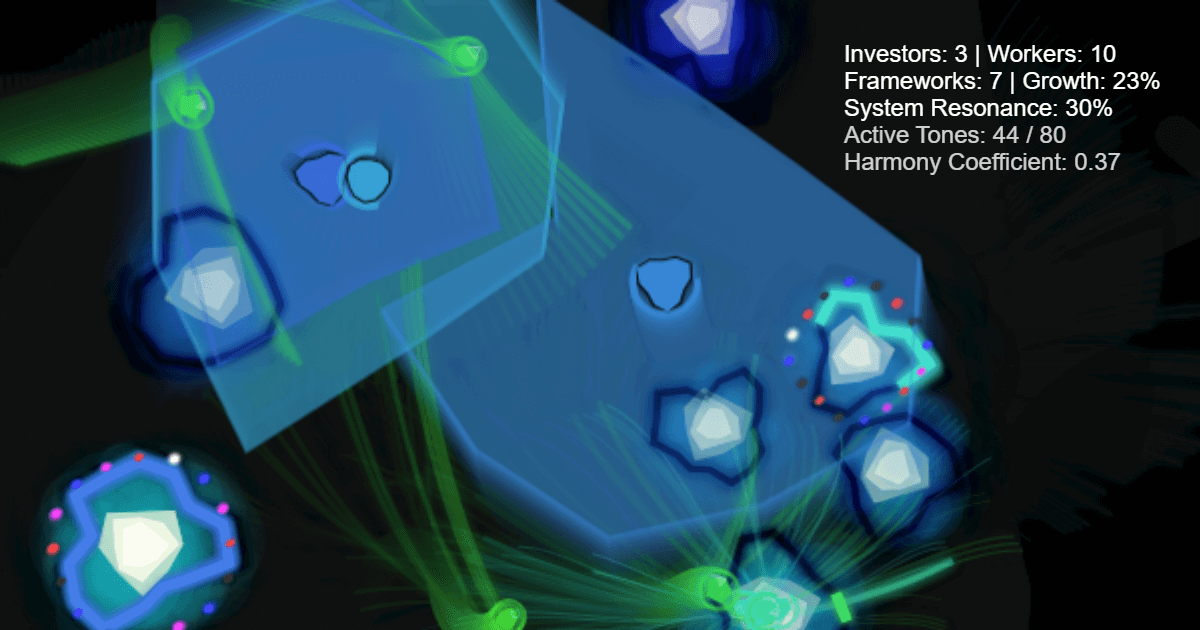
Who Creates Culture?
Work created in 2025/7/26
This work is an interactive net art piece that visualizes and sonifies the complex and abstract process of cultural formation as a real-time simulation. Within a 3D space rendered using WebGL technology, the interactions between two social actors—investors and workers—are expressed as geometric polyhedra. The dynamics of these forms can be experienced through quantified parameters and an ever-shifting soundscape.
The visual language of the piece can be read as a fusion of cybernetic aesthetics and minimalism. Floating polyhedra unified in shades of blue and turquoise function as symbols abstracting the components of contemporary society. Radiating light effects from the center imply the propagation mechanics of cultural influence, while the distinct lights emanating from each polyhedron represent the unique “cultural utterance” of each actor.
This visual choice is deliberate. By situating the artwork itself within a virtual space freed from physical constraints, it embodies the reality that culture production in the digital age occurs in such nonphysical arenas. The viewer does not observe culture from the “outside,” but inhabits the “inside” of the simulation, experiencing the process of cultural formation first-hand.
The continuously changing numerical data displayed in real time hold meaning beyond their face value. The numerical relationships between “investors” and “workers,” the expansion of “frameworks,” the increase in “growth,” and changes in “system resonance” all model the structure of cultural production in modern capitalist society. Especially notable is the conceptual “harmony coefficient,” which quantifies the tension between cultural diversity and unity.
The algorithm presented by the work shifts away from representing culture as a “spontaneous phenomenon,” instead adopting a critical perspective that treats it as a construct produced under specific socioeconomic conditions. The unpredictable yet actor-driven fluctuations in the numbers create a paradoxical structure, reflecting the real-world complexity of cultural hegemony.
As indicated by the display “Active Sounds: 69/80,” the sonic elements are closely tied to the visual simulation. This sound design reimagines culture as not merely a visual or conceptual phenomenon, but as a physical, bodily experience. Soundscapes that shift according to the harmony coefficient immerse the viewer in the auditory dynamics of cultural harmony and dissonance.
The density and texture of sound serve as acoustic expressions of society’s cultural richness and poverty. Setting the upper limit at 80 suggests a cap on the capacity for cultural expression, provoking questions about how to ensure diversity within constraints—a pressing contemporary issue.
This artwork grapples with the tension between the ideal of democratized, decentralized culture formation afforded by the internet and the enduring realities of control by capital and power. The very choice to operate within a web browser stands as a political statement regarding accessibility to culture.
The “Start System” interface simultaneously positions the viewer as an agent of cultural production and exposes the reality that such agency is mediated by algorithms. Here, the viewer is not only “observing” culture but also “activating” it, blurring the boundaries between active participation and passive consumption in cultural formation.
“Who Produces Culture?” offers not analysis of culture as a fixed object, but an experiential encounter with its dynamic process—suggesting a new methodology for cultural studies. Rather than providing answers, the work functions as a dispositif for the continual generation of questions, prompting reflection on cultural subjectivity.
The visualization and sonification of culture using digital technology carve out new territory in artistic expression beyond the reach of conventional art criticism. This work should be seen not as a mere use of technology as a tool, but as a practice that critically examines the impact of technology itself on cultural formation.