The Great Wave off Kanagawa
Internet Art Works Library | NS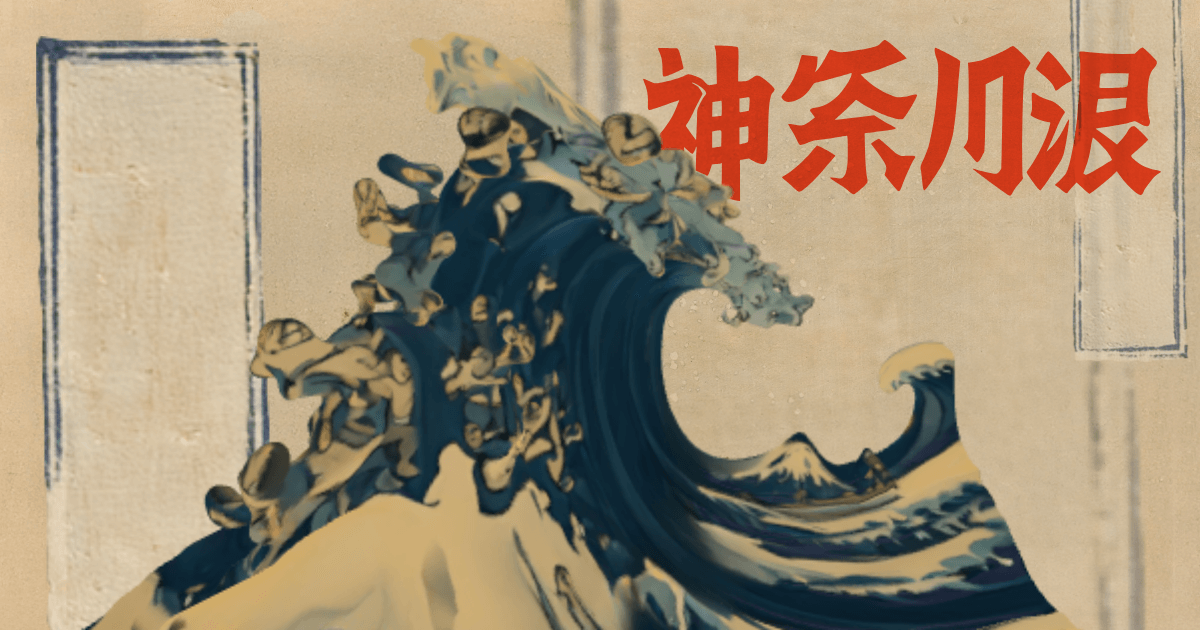
The Great Wave off Kanagawa
Work created in 2025/6/14
This work is an innovative piece of internet art that visually reconstructs Katsushika Hokusai’s “The Great Wave off Kanagawa” and integrates it with an auditory experience based on mixture rock. By boldly fusing classical art from the Edo period with contemporary music culture from the 1990s onward, it creates an unprecedented artistic experience that transcends temporal and cultural boundaries.
The choice to combine Hokusai’s wave—a symbol of Japanese classical art—with mixture rock, which blends diverse musical elements such as rock, hip-hop, funk, and metal, is both highly challenging and meaningful. While this combination may appear discordant on the surface, it actually reveals profound commonalities. The powerful dynamic energy of Hokusai’s wave resonates with the hybrid energy of mixture rock, both sharing a creative destructiveness. Both transcend existing frameworks and share an innovative spirit that pioneers new realms of expression. Just as Hokusai revolutionized conventional painting concepts through the popular art of ukiyo-e in the Edo period, mixture rock has deconstructed and reconstructed the boundaries of established music genres.
The heavy groove of mixture rock, the aggressiveness of distorted guitars, and the mechanical repetition of hip-hop rhythms demonstrate an unexpected affinity with the overwhelming force of nature depicted in Hokusai’s wave. However, at the same time, this music also possesses a roughness that contrasts with the delicate lines and harmonious colors of Hokusai’s work.
This very contrast forms the core criticality of the piece. For urban dwellers surrounded by contemporary urban soundscapes, the power of nature is experienced as something abstracted and mediated. Mixture rock, as an artificial and hybrid form of music, acoustically expresses this modern way of experiencing nature.
The technical choice to generate and play mixture rock via the Web Audio API adds significant meaning to the work. Instead of simply playing back pre-recorded music, real-time audio synthesis enables live mixing that responds to changes in the visual elements. The numerical changes on the screen (such as 90, 102, 155, 140) most likely control the balance and intensity of each element of mixture rock—bass lines, drum patterns, guitar riffs, and sampling. This allows for a data-driven composition in which the shape data of Hokusai’s wave is directly reflected in the musical structure.
The very nature of mixture rock as a blend of multicultural musical elements deeply resonates with the cultural identity of contemporary Japan. By combining Japanese classical art with mixture rock—a fusion of Western music and African-American music—the work expresses the complex cultural experiences of the globalized era in both sound and vision.
This piece does not aim to merely preserve pure Japanese culture or imitate Western culture, but rather presents a third cultural possibility born from the creative collision of disparate elements. By uniting Hokusai’s universal formative power with the hybrid energy of mixture rock, it deconstructs the myth of cultural purity and demonstrates that hybridity is the true source of creativity.
The coexistence of the physical groove of mixture rock with the meditative temporality of ukiyo-e appreciation creates a unique mind-body experience. The heavy bass lines and repetitive rhythms synchronize the body with the music, while the visual fluidity of Hokusai’s wave leads the mind into a state of introspection.
This simultaneous presence of opposing elements accurately reflects the split consciousness of modern people—bodies exposed to urban stimuli while minds yearn for classical beauty. By intentionally placing the viewer in this contradictory state, the work enables an experiential understanding of the complexity of contemporary sensibility.
By dismantling such dichotomies as classical and contemporary, East and West, high and popular, static and dynamic, visual and auditory, and by creating new aesthetic categories, this work stands as an ideal example of postmodern aesthetics in practice. However, it goes beyond mere eclecticism, as each element is organically integrated to achieve a unique aesthetic unity.
This “Kanagawa Wave” functions as a manifesto for the possibilities of art in the globalized cultural environment of the 21st century. It presents, through a superb integration of sound and vision, one answer to the challenges faced by contemporary art: the inheritance and innovation of tradition, the exploration and transcendence of cultural identity, and the fusion of technology and art. The choice of mixture rock as the musical foundation decisively shapes the rebellious spirit and experimental nature of the work, greatly enhancing its critical significance as a whole.