Neo-Cubism
Internet Art Works Library | NS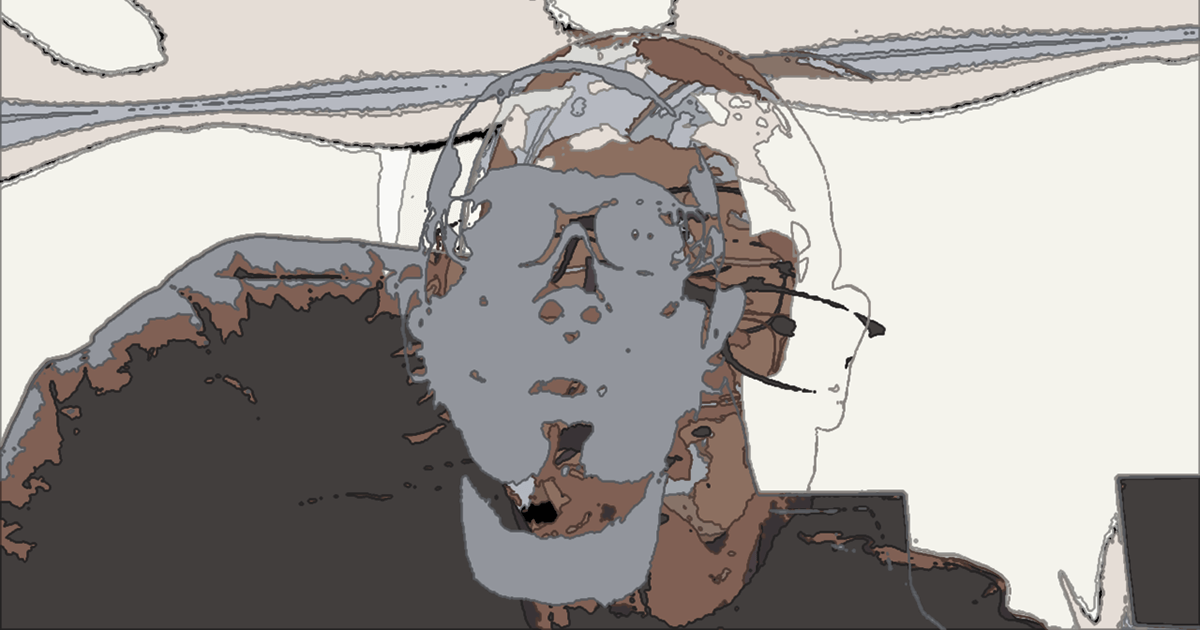
Neo-Cubism
Work created in 2025/11/29
'Neo-Cubism' is an interactive artwork that deconstructs and reconstructs reality captured through a webcam, using only chromatic information to form a multi-perspectival visual experience. As the title suggests, just as early twentieth-century Cubism sought to depict subjects from multiple viewpoints simultaneously, this work translates multiple frames taken along the temporal axis into layered compositions reduced to the element of color.
At the core of this piece lies a process that classifies the live camera feed into groups of similar hues and extracts them as contour lines that are accumulated over time. Each time the user presses the capture button, the current frame is analyzed by color and separated into hue groups—such as purples, blues, or blacks. These color regions are then extracted as outlines and added onto existing layers.
What makes this algorithm fascinating is that it focuses not on the form of the subject but on its color distribution. Concrete objects such as a human face, furniture, or lighting are merely implied through their outlines, while the final image is governed by a map of color distribution. With each act of capturing, contours of similar hues accumulated from different moments overlap, transforming photographic reality into an abstract color map.
While Picasso and Braque attempted to approach three-dimensional truth by depicting forms from multiple spatial perspectives, this work introduces temporal multidimensionality. Each consecutively captured frame represents the same space at a different moment in time; when layered through the common language of color, the accumulation of time becomes visible.
Yet this marks a crucial shift. Whereas Cubism sought structural truth in form, Neo-Cubism distances itself further from figuration by extracting only the abstract element of color. The small live feed displayed in the upper right corner functions as a reference point to reality, emphasizing the contrast between the raw camera image and the central field of abstract color composition.
The aesthetic value of this work depends not on intentional composition but on the user's timing—a form of chance. When the participant moves, new color regions appear; when still, existing contours reinforce themselves. In this sense, the process echoes Jackson Pollock's action painting, translating physical chance into temporal chance within a digital space.
As capturing continues, the image becomes increasingly complex. Initial outlines, once simple, are gradually buried yet remain as traces beneath newer layers. This cumulative process resembles the buildup of brushstrokes in painting, with the distinction that here, layers unfold along the dimension of time.
The choice of the webcam as a device is also significant. In contemporary society, the camera operates both as a tool of surveillance and as an instrument of self-expression through video calls or selfies. By inviting users to record themselves and their surroundings, this work embodies the duality of surveillance and self-observation, objectification and agency.
The continuously displayed 'raw camera image' in the upper corner evokes the feed of a surveillance camera, constantly reminding the viewer-photographer of their own visibility. At the same time, the extracted color contours function as visual fingerprints—highly personal and unique, producing distinct patterns even within the same space depending on timing and movement.
The limitations of the work are also evident. The simplicity of color extraction constrains visual diversity to some extent. Depending on lighting or the color composition of the scene, the expected richness of contours might not emerge. Moreover, repeated captures can lead to excessive complexity, risking a loss of clarity.
However, this very simplicity is also the work's strength. By focusing on the universally accessible element of color rather than complex algorithms, it lowers technical barriers while engaging with enduring themes—color and time, observation and record, figuration and abstraction.
'Neo-Cubism' is a visual experiment staged within the democratic space of the web browser. No special software or advanced technical knowledge is required. All that is needed is a camera and the simple act of pressing a button. Yet within that simplicity lie layered explorations: the essence of color, the visualization of time, and the possibilities of digital self-expression.
Rather than a completed artwork, this piece is an open experimental apparatus. The color patterns generated by each participant depend on their environment, movements, and timing, resulting in a singularity that can never be replicated. In this sense, Neo-Cubism is not merely a contemporary reinterpretation of Cubism but an exploration of a new visual language for the digital age.