Still life
Internet Art Works Library | NS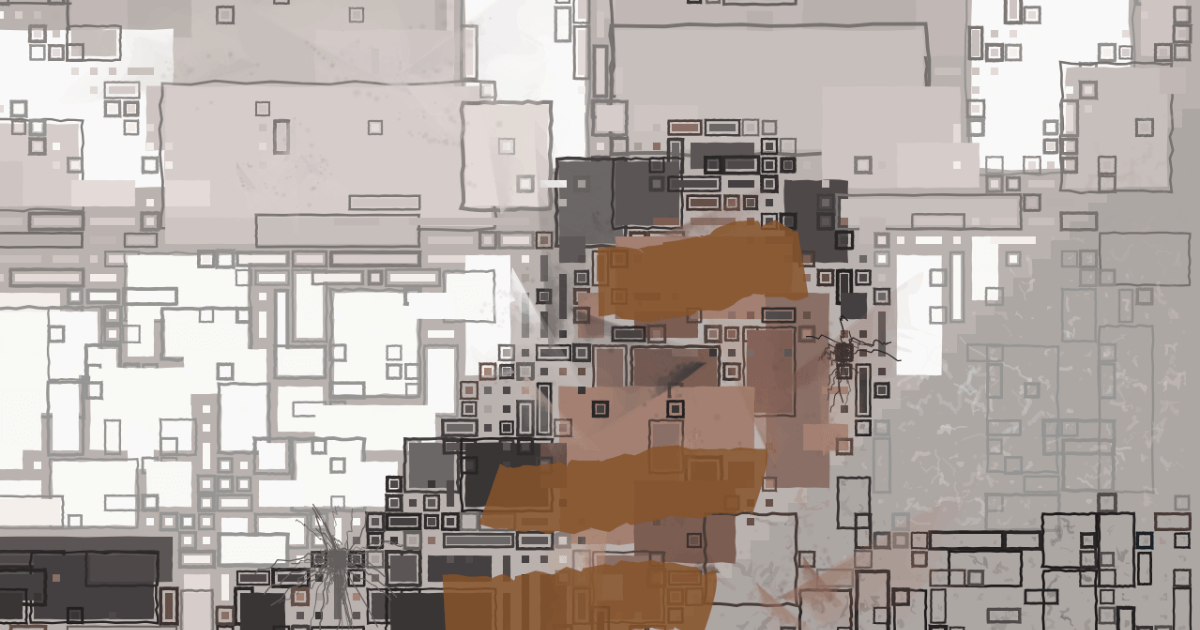
Still life
Work created in 2025/11/1
'Still life' — Traditionally meaning 'a painting of inanimate objects', this term, when placed in the context of generative art, becomes an attempt to question the very concept of still life in art history.
In Western art, still life was the act of freezing time by depicting unmoving subjects. Fruits, flowers, dishes — they remain eternally 'still' on the canvas. Yet in this work, every time the viewer presses the '📷 Capture Still Image' button, a new image is generated, each one different from the last. It is therefore a paradoxical existence: a 'still life' that never holds the same form.
Visually, its most distinctive feature is the combination of geometric line drawings reminiscent of architectural plans or floor layouts with amorphous color fields. Upon the rational and rectilinear spatial representation, organic clusters in restrained hues of blue, gray, and beige are arranged. These two elements interfere with one another yet never fully merge, maintaining a kind of tension between them.
This can be read as a visualization of the coexistence between artificial structure (architecture) and natural contingency (generative algorithm). Alternatively, it might be seen as an abstract depiction of the concept of 'dwelling' in digital space — the various 'places' we construct on the web.
The music generated with Tone.js serves as an essential counterpart to the visual stills. When the viewer chooses '🎵 Play Music', sound begins to flow in response to the image. This is not mere 'background music' but rather a twin of the visual form, both born from the same algorithmic source.
Here, too, the theme of 'stillness' is overturned. Still life is originally an art of silence, yet the 'still image' in this work possesses sound. Moreover, that sound, like the image, takes on a different form each time. Through both sight and hearing, the viewer experiences a unique, unrepeatable moment within digital space.
The interface '📷 Capture Still Image' symbolizes the critical stance of the work. Like pressing a camera shutter, the viewer extracts a single 'photograph' from this virtual environment. But what appears there is not a preexisting landscape — it is one generated for the first time precisely through the act of pressing the shutter.
Photography has traditionally been a medium for recording reality. Yet in this work, the shutter becomes a device of creation rather than documentation. The viewer is placed not as an observer, but as a co-creator.
Ultimately, this work can be seen as an experiment exploring the possibilities of 'still life' in the 21st century — not as a fixed image, but as a bundle of endlessly transformable potential; a multimodal experience that engages both vision and hearing; and above all, a reconfiguration of the relationship between artwork and viewer.
The title 'Still life' is both ironic and hopeful. In digital space, 'stillness' does not exist. Everything flows, everything continues to be generated. Yet within that continual flow, there may reside a new kind of 'quiet' — the quiet of algorithms, the quiet of computational aesthetics.