Techno-Fauvism
Internet Art Works Library | NS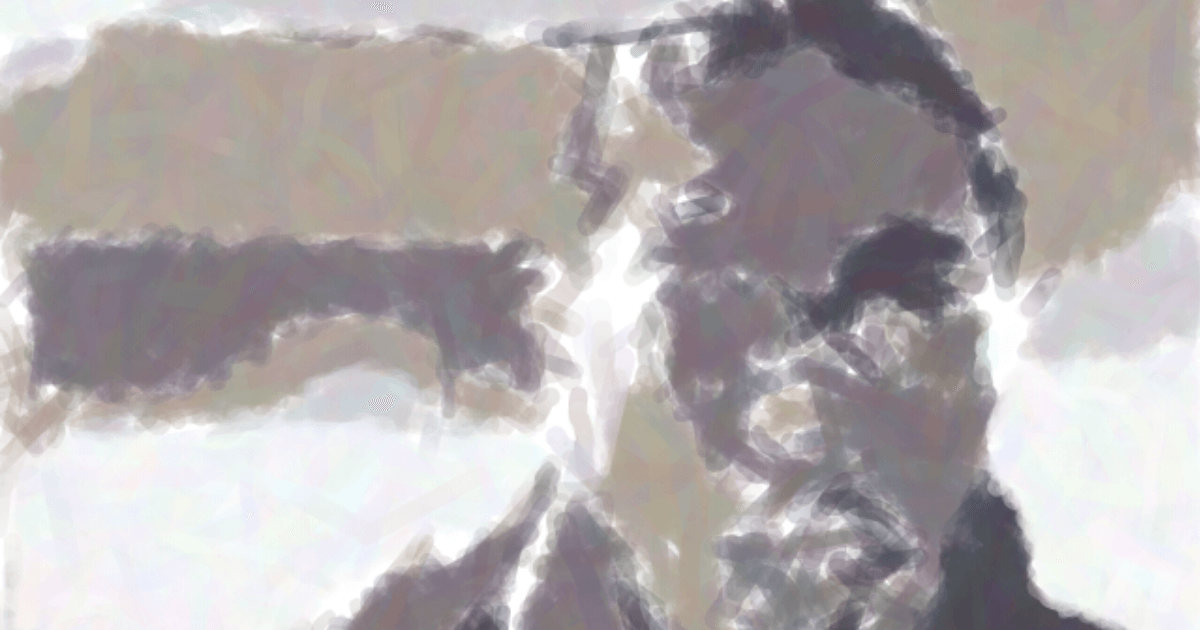
Techno-Fauvism
Work created in 2025/12/6
'Techno-Fauvism' is an attempt to reinterpret the aesthetic principles of Fauvism, an early 20th-century avant-garde movement, through contemporary web technologies. The 'liberation of color' pursued by Matisse and Derain — a pure color expression guided by emotion and intuition that rejects faithful representation of nature — is revived in the present through real-time image-processing algorithms.
At the core of the work lies a process in which an algorithm instantly transforms the reality captured by a webcam into a painting. This transformation is not a mere filter effect but a twofold creative process involving the reconstruction of color space and the generation of brushstrokes. The image is first divided into multiple color groups, from which dominant hues are extracted. Next, broad strokes are generated within those color regions, realizing the wild yet vibrant expressiveness characteristic of Fauvism.
What makes this work particularly suggestive is the way it converts the webcam, a device of surveillance, into a tool for aesthetic production. In modern society, cameras have consistently functioned as instruments of power and observation. 'Techno-Fauvism', however, inverts this gaze, creating a space where the observed subject transforms their own body and environment into materials for artistic creation.
By pressing the '📸 Transform into Painting' button, the user can instantly metamorphose everyday scenes or self-images into Fauvist-style paintings. This act signifies a shift from the passive state of 'being observed' to the active position of 'creating'. The experience of sublimating one's own image into an artwork can be read, in Foucauldian terms, as a contemporary development of the 'technologies of the self'.
The transformation from vision to sound forms another core of the work. Using the Tone.js library, extracted color data are mapped onto musical parameters. The musical information displayed — 'Mixolydian scale', '120 BPM', 'Bass ×1, Pad ×2, Lead ×2 + Drums' — is not accidental but the necessary outcome derived from the image’s color distribution.
It is fascinating that this process of musical generation, though fully deterministic, simultaneously produces aesthetically unpredictable surprises. Even within the same room and lighting, tiny changes in body movement or light alter the color distribution, yielding entirely different music. This mirrors how the Fauvist painters, facing the same landscape, expressed it in radically different colors. In a sense, the algorithm mathematically implements what could be called the 'intuition' of the 20th-century artists.
Another significant aspect of this work concerns temporality brought by real-time processing. While traditional paintings result in the suspension of time, 'Techno-Fauvism' repeatedly captures, transforms, and erases the moment. With the '🔄 Initialize' button, everything resets, awaiting the next generation — a structure that embodies the ephemerality and repetition of the digital age.
The paintings and music generated in each session vanish without being recorded. This singularity aligns with the tradition of live performance and happening art, while also quietly resisting the contemporary trend toward excessive data accumulation and permanence. The work refuses documentation and instead asserts the immediacy of experience.
From a technical perspective, the work is notable for operating entirely within the browser, requiring no special hardware or software. By relying solely on web standard technologies such as WebGL, Canvas API, and Web Audio API, it ensures the democratic accessibility fundamental to internet art.
Just as the Fauves broke free from academic norms, this work opens the possibility for artistic creation without expensive materials or professional training. Through an everyday device — the webcam — and a single click, anyone can become a creator of Fauvist expression. This situates the work within the broader context of the democratization of art through technology.
However, the work also contains a tension worth questioning: does algorithmic reproduction of Fauvism truly capture the 'inner necessity' that Matisse and Derain sought? Can brushstroke generation defined by mathematical formulae genuinely include the traces of the artist’s bodily and emotional expression?
The work’s response to this question is likely an honest affirmation of 'it does not'. And therein lies its strength. 'Techno-Fauvism' does not aim to reproduce Fauvism perfectly but rather to explore the possibility of Fauvist expression through a different 'subject' — the algorithm itself. It is not a mimicry of human intuition but an autonomous aesthetic judgment made by computation.
The choice of a specific musical mode, such as the Mixolydian scale, and the ensemble of five instruments carry a degree of arbitrariness. Why Mixolydian? Why a single bass? These choices are not purely derived from color data but involve the designer’s aesthetic interventions. In this sense, the boundary between total algorithmic determinism and human artistic interference remains ambiguous, an ambiguity that becomes a source of the work’s intriguing duality.
'Techno-Fauvism' thus opens a new horizon of computational aesthetics through the dialogue between historical avant-garde and modern technology, the aesthetic repurposing of surveillance devices, the synesthetic integration of vision and sound, and the exploration of temporality through real-time processing.
It is not merely a digitalization of a past art movement but an experiment that questions the potential of the algorithm as a new creative agent. Just as the Fauves painted not 'what they saw' but 'what they felt', the algorithms in this work generate 'what they compute' — and when the outcome of that computation yields unexpected aesthetic surprise, a new relationship between technology and art begins to take shape.